
Navigating the High-Growth Contingent Workforce Economy
The U.S. staffing market reached $184 billion in 2024, according to research from SIA. That number tells you everything about where workforce strategy is headed. Moreover, this figure highlights the increasing importance of adaptable workforce models. Globally, the contingent workforce management market is projected to reach $465.2 billion by 2031, a 271% increase from its 2021 value, growing at 10.5% annually according to Allied Market Research. As a result, organizations are rethinking how they source and manage talent worldwide.
The Strategic Shift to Agile Talent Models
Bringing in contractors and flexible talent used to be a last resort. However, now it’s how modern companies stay ahead. In fact, this shift is only accelerating as organizations move toward more flexible, skill-based hiring, or contingent workforce management. Consequently, businesses that adapt quickly will maintain a competitive edge, while those that do not may fall behind.
Governance in the Era of Workforce Solutions 2026
With this rapid expansion comes a significant learning curve for HR and procurement leaders. As a result, many are left asking: What are the common mistakes in contingent workforce management? Whether you’re sourcing talent domestically or expanding into international markets, it is essential to know how a Managed Service Provider (MSP) and Employer of record (EOR) work together (and where they don’t).
By understanding these dynamics, you can save your organization a lot of headaches. Ultimately, this guide explores the most common pitfalls in contingent workforce management and demonstrates how a compliance-first strategy can turn these risks into a competitive advantage.
What Is Contingent Workforce Management?
Contingent Workforce Management (CWM) is the strategic process of sourcing, engaging, managing, and offboarding non-permanent workers, including independent contractors, temporary staff, and SOW-based (Statement of Work) consultants. In practice, an effective CWM program centralizes oversight to ensure cost-efficiency, visibility, and total compliance. Therefore, organizations benefit from consistent processes and reduced risk.
The Strategic Role of an MSP
A Managed Service Provider (MSP) serves as the strategic framework for your entire contingent workforce program. Essentially, it acts as an outsourced department that manages the end-to-end lifecycle of the flexible workforce, vendor oversight, and data analytics needed for executive-level decision-making. As a result, a unified program, employers gain visibility, reduce costs, and improve the quality and speed of contingent talent delivery.
What is an EOR?
Choosing from the best employer of record services in the US requires looking past simple payroll processing. Furthermore, enterprise-grade solutions must integrate directly into your MSP framework to ensure compliance with domestic labor laws (which vary significantly by state).
Within that MSP framework, an EOR serves as the compliance and execution component. While the MSP manages the strategy, the EOR acts as the legal employer for specific workers, handling payroll, taxes, and benefits. Consequently, this shields the client company from co-employment and misclassification risks.
10 Mistakes to Avoid in Contingent Workforce Management
To achieve enterprise-grade agility, organizations must move beyond reactive hiring. Otherwise, making just one of these errors can unravel the entire program. Below are 10 mistakes that can compromise your contingent workforce’s integrity, along with how to resolve them through an integrated contingent workforce management partner through MSP and EOR solutions.
1. Treating Contingent Hiring as an Ad-Hoc Requirement
Many firms allow individual department managers to hire contractors independently. As a result, this “rogue spend” leads to inconsistent pay rates and zero visibility into total headcount.
- The Risk: Escalating costs and an inability to forecast labor needs. Consequently, companies may struggle to plan for future workforce requirements.
- The Solution: Bring in a workforce solutions provider to centralize all hiring requests. In doing so, you standardize the process and gain a unified view of your “liquid” workforce, allowing for better budget control.
2. Misclassifying Workers (Independent Contractor vs. Employee)
The U.S. Department of Labor (DOL) and the IRS have intensified their scrutiny of worker status. For example, in 2025, the DOL reverted to “economic reality” principles to determine if a worker is truly an independent contractor or an employee.
- The Risk: Back taxes, unpaid overtime, and massive penalties. In California alone, recent misclassification citations have exceeded $2 million for single organizations.
- The Solution: Use an EOR for any worker who does not meet strict independent contractor criteria. In this way, the EOR assumes all legal employer responsibilities, ensuring compliance with federal and state laws.
3. Ignoring Co-Employment Liability
Co-employment occurs when a client company begins directing a contractor’s work so closely that courts treat it as the actual employer.
- The Risk: The company may become liable for the worker’s benefits, workers’ compensation claims, and labor law violations. Therefore, it is crucial to maintain clear boundaries between employees and contractors.
- The Solution: A strategic MSP sets clear boundaries between your team and contingent workforce. An EOR backs that up by staying the formal employer of record, keeping your company from crossing that (legal) line.
4. Fragmented Vendor Management
Working with dozens of different staffing agencies without a central point of contact creates chaos for your admin team. Furthermore, this lack of centralization can result in redundant processes and communication breakdowns.
- The Risk: Inconsistent contract terms, varying background check standards, and high markups. As a consequence, your organization may face elevated costs and compliance risks.
- The Solution: Centralize through an MSP. The MSP manages the vendor ecosystem, ensuring all suppliers adhere to the same compliance and pricing standards.
5. Lack of Centralized Data and Spend Visibility
Without a unified platform, it is impossible to know how much you are spending on contingent labor across different regions or departments. As a result, you may overlook opportunities for cost savings or process improvements.
- The Risk: Inefficient resource allocation and difficulty in demonstrating ROI to stakeholders. Ultimately, this can undermine executive support for your contingent workforce program.
- The Solution: An MSP-led program uses a Vendor Management System (VMS) to surface real-time workforce data. This supports what Gartner calls “talent remixing,” the practice of strategically reshaping your workforce mix to hit business goals.
6. Poor Global Expansion Planning
Attempting to hire in new countries without a local legal entity often results in shadow payrolls and noncompliance with local labor laws. Consequently, your organization could be exposed to severe legal and financial penalties.
- The Risk: Severe fines and potential bans from operating in certain jurisdictions.
- The Solution: Integrate a Global EOR service. As a result, you can hire talent in any country without the cost or time required to set up local entities, ensuring local tax and benefit compliance from day one.
7. Weak Onboarding and Offboarding Controls
Contingent workers often have access to sensitive IP and internal systems. If they are not offboarded correctly, that access may remain active indefinitely. For this reason, robust offboarding procedures are essential.
- The Risk: Data breaches, IP theft, and corporate espionage. Moreover, Gartner predicts that insider threats will become more significant by 2026 as usage of AI tools increases.
- The Solution: Use a workforce management partner to standardize the onboarding/offboarding workflow, ensuring that all NDAs are signed, and that system access is revoked immediately upon contract termination.
8. Choosing an EOR Based Solely on Price
A transactional EOR may offer low fees but lack high-touch service and the legal infrastructure to handle complex state-specific or international labor issues. Therefore, it pays to look beyond pricing alone when choosing an EOR partner.
- The Risk: Hidden compliance gaps that only surface during an audit. In turn, these issues can result in costly legal exposure.
- The Solution: Evaluate providers based on their compliance infrastructure and consultative depth. The best employer of record services in the US provide compliance-first solutions and local expertise in high-stakes markets like California, New York, and Illinois.
9. Inadequate Data Governance (GDPR/CCPA)
Managing the personal data of a global contingent workforce requires strict adherence to privacy laws. Otherwise, your organization can be subject to significant reputational and financial harm.
- The Risk: Massive fines for data mishandling and loss of consumer trust. As such, data governance should be a top priority for any company leveraging international talent.
- The Solution: An enterprise-ready MSP/EOR ensures that all workforce data is stored in secure, encrypted environments that meet global privacy standards.
10. Lack of Strategic Alignment Between MSP and EOR
If your MSP and EOR operate in silos, the strategy will fail during execution. To avoid this, it is important to align both solutions from the outset.
- The Risk: Delays in hiring, communication breakdowns, and increased administrative burden on HR. Consequently, your business may experience lost opportunities and reduced productivity.
- The Solution: Partner with a single provider that can offer both MSP strategy and EOR execution. This unified workforce solution creates a seamless experience for both managers and workers.
MSP vs. EOR: Which Solution Does Your Business Need?
Understanding the distinction between MSPs and EORs is critical for mid-market and enterprise firms. While both offer workforce support, they solve different pain points.
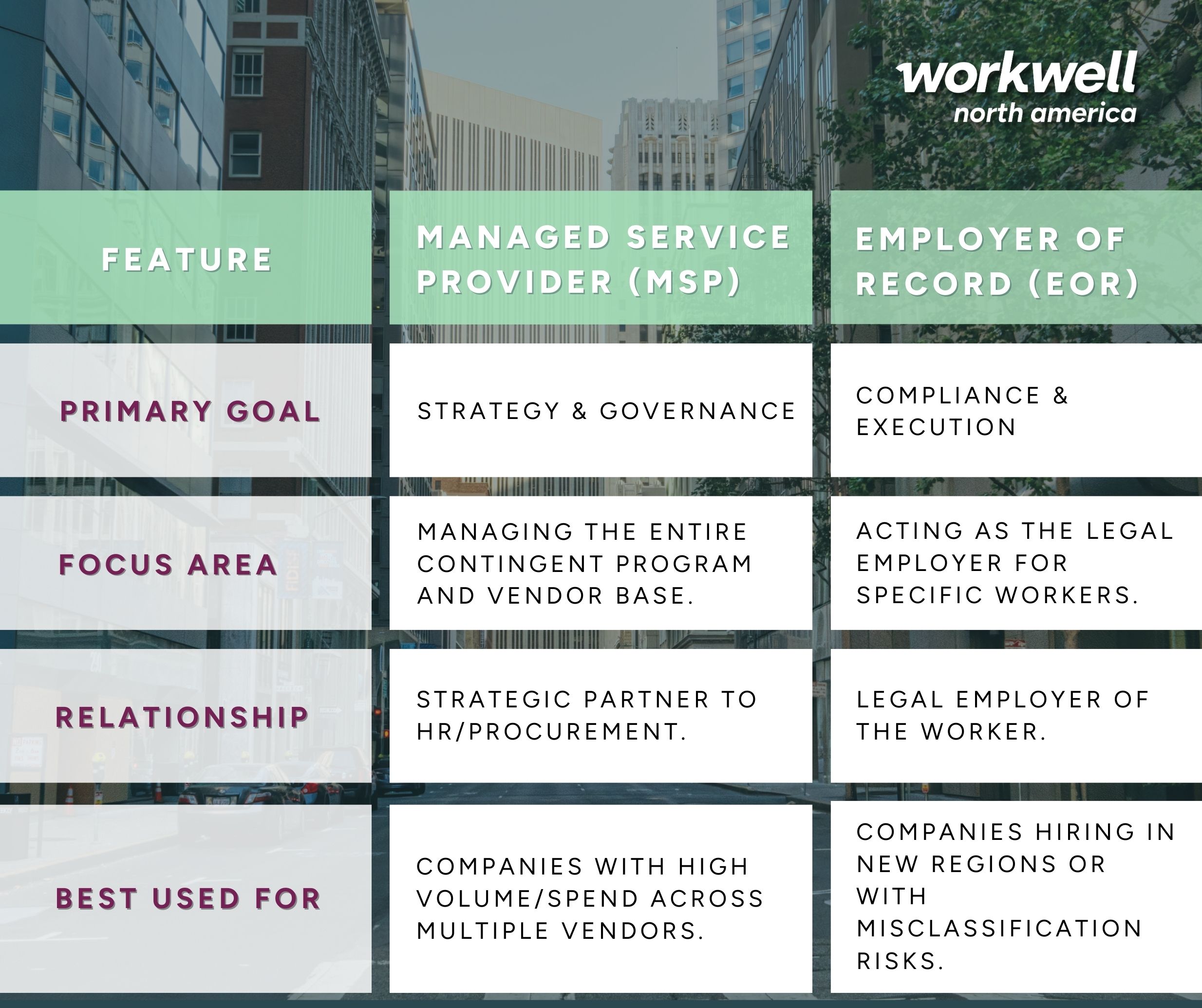
Many organizations find that the answer to MSP vs. EOR isn’t “one or the other,” but rather a hybrid approach. Specifically, for organizations that utilize multiple staffing vendors, the MSP provides the overarching program governance and vendor management, while the EOR serves as the specialized legal employer for high-risk or international worker segments. This “best of both worlds” strategy is becoming the new norm for workforce solutions 2026.
Why Workwell North America?
Having compared MSPs and EORs, why partner with Workwell North America for your workforce strategy? In an era of rapid workforce transformation, you need a strategic partner. For this reason, Workwell North America brings decades of experience to the table, providing a bridge between complex domestic requirements and global growth.
- Compliance-First Solutions: We prioritize risk mitigation in everything we do, from vetting independent contractors to international tax compliance. In fact, our compliance-first approach has helped companies avoid costly mistakes time and again.
- Strategically Consultative: We don’t just provide software; we provide expertise. Additionally, our teams work with you to design a workforce program that aligns with your specific business goals.
- Seamless Scalability: Whether you are hiring your first remote worker in a new state or managing a global contingent workforce of thousands, our infrastructure scales with you. As your needs evolve, we are prepared to support your continued growth.
- Domestic & Global Excellence: We provide a unified solution for North American companies looking to win in global hiring. As such, our expertise covers both local and international compliance needs seamlessly.
Take the Next Step in Your Workforce Strategy
Don’t let fragmented processes and compliance gaps hold your business back in this new talent economy. Instead, Workwell North America is ready to help you implement the next generation of workforce solutions in 2026 to build a resilient, scalable, and compliant workforce.

Get in Touch
Explore which contingent workforce management option is best for your organization.