

Fragmentation is the most common failure mode in contingent workforce programs, and it builds through reasonable decisions like adding vendors by region, adopting point tools for specific needs, and patching gaps between disconnected systems. The program may still look functional, but scale reduces visibility, creates compliance inconsistencies, blurs accountability, and slows expansion. The solution is workforce unification: an operating model with clear ownership, standardized workflows, and a true system of record. Leaders can tie this framework directly to outcomes that matter: revenue protection, audit readiness, and workforce agility.
In our previous post, we outlined the real risk inside many contingent workforce programs: fragmentation. This fragmentation in a workforce is often a slow, creeping problem that results from the cumulative spread of work across vendors, tools, contracts, and owners, until programs become harder to operate, riskier to manage, and slower to scale.
This follow-up to the fragmentation issue addresses the next question program leaders ask after becoming aware of the problem: How does a scalable workforce unification framework translate into concrete business outcomes such as revenue protection or enhanced workforce agility? Redirecting attention from process to outcomes can better engage non-HR leaders and encourage program alignment.
Because the fix isn’t more technology or fewer vendors on its own. It’s an operating model that enables visibility, compliance, and performance as your workforce expands across geographic areas, worker types, and engagement models.
And the need is real. The latest BLS Contingent Worker Supplement found that there are 6.9 million contingent workers, representing 4.3% of all employed workers (up from 3.8% in 2017). That number doesn’t even capture the full complexity most enterprises manage today (contractors, SOW services, global engagement models, and more).
Why Contingent Workforce Programs Break As They Scale
Fragmentation rarely shows up as a dramatic failure. It shows up as rational, incremental decisions: another vendor for another geography, a point solution for a specific workflow, a workaround to bridge systems that weren’t designed to work together.
From the outside, the program still looks functional. But at scale, the unintended consequences become consistent:
- Limited visibility into spend, risk, and performance
- More errors and misclassification risk from manual or inconsistent processes
- Inconsistent contracts and governance
- Unclear vendor accountability
- Slower global expansion than it should be
One line from our fragmentation post matters here because it’s the trap most teams fall into:
Visibility follows ownership, so when ownership is split, data is split too, and keeping up with better reporting becomes difficult. That’s why the Unification Framework starts with decisions about the operating structure.
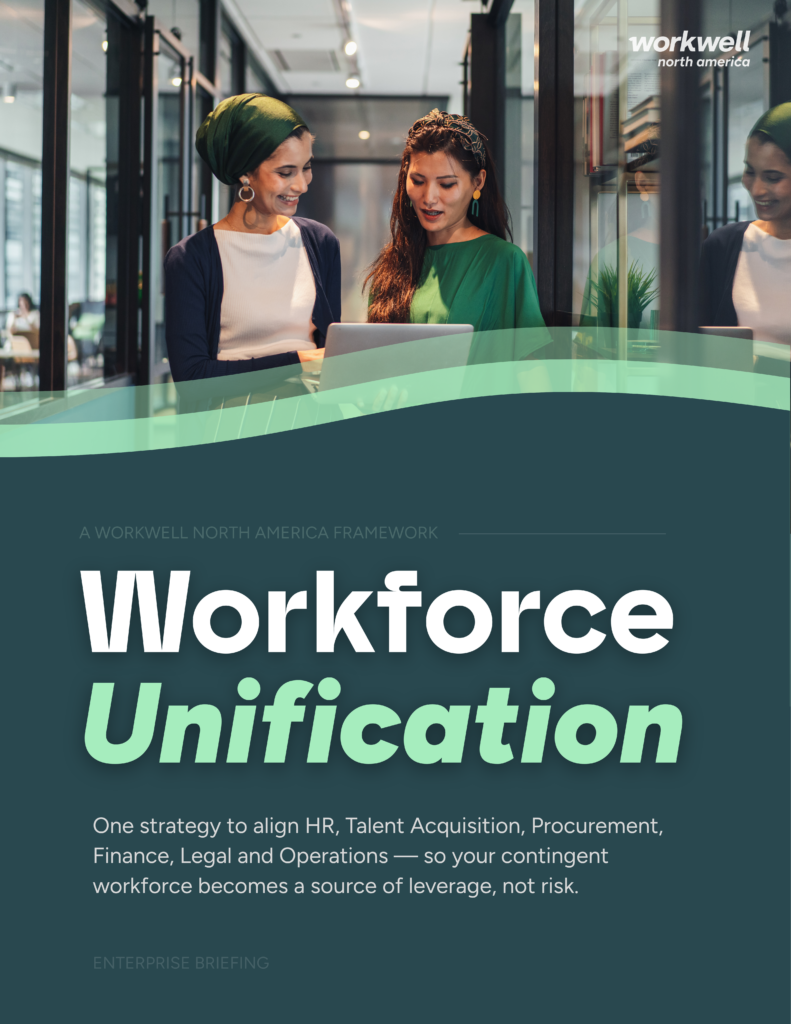
DOWNLOAD WORKFORCE UNIFICATION FRAMEWORK
What is the Workforce Unification Framework?
The workforce unification framework is a structured way to manage non-employee labor so programs can maintain workforce agility with:
- Clear ownership and decision rights
- Standard operating sequences (intake → classification → onboarding → timekeeping/invoicing → offboarding)
- A system of record that enables real visibility and compliance
In other words: it’s how you turn a collection of “mostly working” parts into an enterprise program that performs consistently across stakeholders, geographies, and worker types.
People, Process, Platform
This framework is built on three interdependent components: People, Process, and Platform.
Imagine these components as the three legs of a tripod as each is essential for stability. Without one, the entire structure risks collapsing. This imagery can help diverse stakeholders easily recall the model, especially under pressure.
Stakeholder Outcomes, KPIs, and Strategic Alignment
A workforce unification strategy sticks when every stakeholder wins by connecting KPIs to enterprise-level OKRs, ensuring strategic alignment without trade-offs that create resistance. For instance, aligning HR’s KPI for timely onboarding with the company’s OKR to increase workforce efficiency can strengthen this link.
We break down practical proof-of-performance measures you can use to build a shared scorecard inside the white paper.
FAQ
What is contingent workforce management?
Contingent workforce management is the strategy and operational system for sourcing, onboarding, managing, and paying non-permanent workers—while maintaining visibility, compliance, and performance across suppliers, regions, and business units.
Why is fragmentation such a problem in contingent workforce programs?
Because fragmentation spreads ownership and data across tools, vendors, and functions—creating partial visibility, more exceptions, and unclear accountability. Over time, programs become slower and riskier to run, even if nothing looks “broken” on the surface.
Can technology alone solve contingent workforce risk?
No. Technology helps, but without unified ownership and standard processes, tools mirror the same fragmentation—data in multiple places, inconsistent workflows, unclear accountability.
What should I implement first?
Clarify ownership and standardize one end-to-end workflow (intake → classification → onboarding → timekeeping/invoicing). The pilot shared reporting using shared definitions.
What is contingent workforce management?
Contingent workforce management is the strategy and operational system for sourcing, onboarding, managing, and paying non-permanent workers—while maintaining visibility, compliance, and performance across suppliers, regions, and business units.
Why is fragmentation such a problem in contingent workforce programs?
Because fragmentation spreads ownership and data across tools, vendors, and functions—creating partial visibility, more exceptions, and unclear accountability. Over time, programs become slower and riskier to run, even if nothing looks “broken” on the surface.
Can technology alone solve contingent workforce risk?
No. Technology helps, but without unified ownership and standard processes, tools mirror the same fragmentation—data in multiple places, inconsistent workflows, unclear accountability.
What should I implement first?
Clarify ownership and standardize one end-to-end workflow (intake → classification → onboarding → timekeeping/invoicing). The pilot shared reporting using shared definitions.
What’s next
Fragmentation may not feel like the most urgent risk in your program today. However, for many organizations, it’s already the most consequential one.
If you want to turn the concepts above into a practical roadmap, start by using the checklist within the white paper to identify risks, gaps, or misalignment across your workforce programs.
Ready To Work Better?
See how Workwell North America combines expertise, technology, and service to simplify contingent workforce management.