

Immigration enforcement visits to workplaces have increased significantly in recent months. Many of our clients have asked what they need to know if ICE visits the workplace and how to respond lawfully while protecting their company, their employees, and contractors from unnecessary legal exposure.
This article provides practical guidance on what employers should do (and not do) during ICE visits, including considerations for contingent workers.
Stay Calm and Get Help Immediately
The most important thing you can do is contact your Legal department or outside counsel right away. Do not attempt to handle an ICE visit on your own. Immigration enforcement encounters can be legally complex, and decisions made under pressure can create significant liability.
Direct agents to a designated meeting area (such as a conference room near reception) and immediately escalate to your legal department or outside counsel.
Understand What Type of Authority ICE Has
Not all warrants are created equal, and understanding the difference is critical to knowing what you must allow and what you can lawfully refuse during ICE visits.
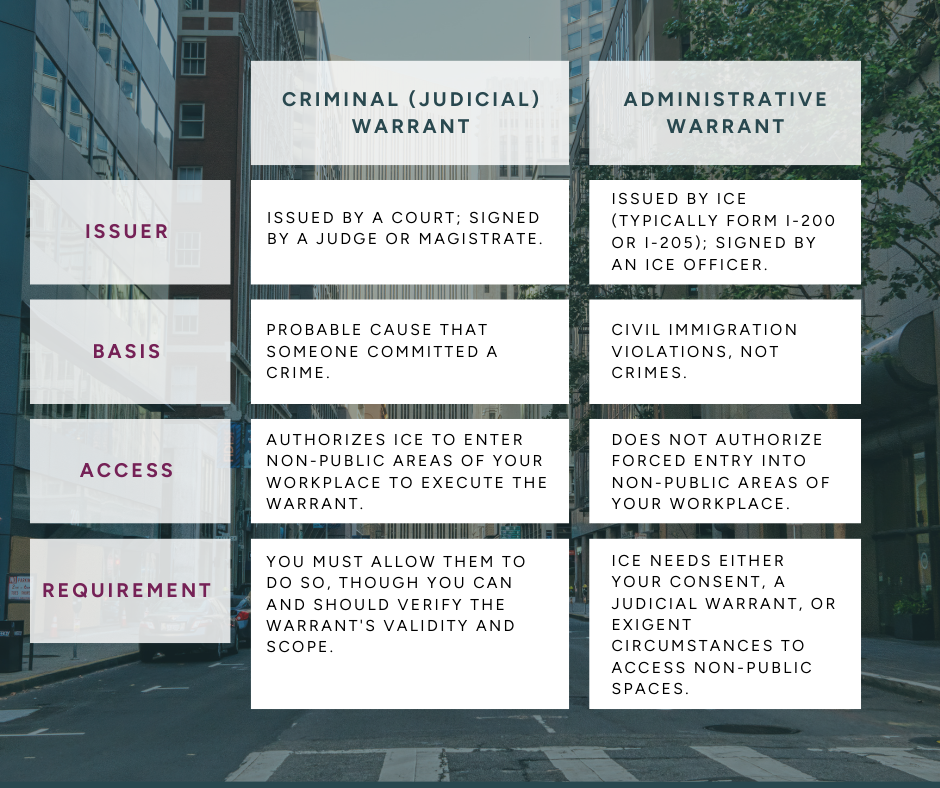
Criminal Warrants (Judicial Warrants)
A criminal warrant is issued by a court and signed by a judge or magistrate. It’s based on probable cause that someone committed a crime. These warrants typically say “United States District Court” or a state court name at the top and include a judge’s signature.
What this means for you: A valid judicial warrant generally authorizes ICE to enter non-public areas of your workplace to execute the warrant. You must allow them to do so, though you can and should verify the warrant’s validity and scope.
Administrative Warrants
An administrative warrant is issued by ICE itself (typically Form I-200 or I-205). These documents have “Department of Homeland Security” at the top and are signed by an ICE officer, not a judge. They’re based on civil immigration violations, not crimes.
What this means for you: Administrative warrants do not authorize forced entry into non-public areas of your workplace. ICE needs either your consent, a judicial warrant, or exigent circumstances (such as hot pursuit of a suspect or imminent danger) to access offices, production floors, break rooms, or other employee-only spaces.
The key question to ask: “Is this warrant signed by a judge?”
California’s Consent Rules: AB 450
California employers operate under the Immigrant Worker Protection Act (AB 450), which specifically limits what you can consent to during an ICE visit.
Under AB 450, you cannot provide ICE access to non-public areas of your workplace unless ICE has a judicial warrant signed by a judge. Violating this law exposes your company to civil penalties of $2,000 to $10,000 per violation.
What to say: “We will comply with any valid legal process. We are not consenting to any search beyond what the law requires.” This simple statement helps protect your company from both federal claims of obstruction and state law violations.
The Accidental Consent Problem
The most common mistake employers make is accidental consent. Someone trying to be helpful says “sure, come on back” or “let me show you to the break room” without realizing they’ve just given ICE legal permission to access non-public areas.
Once you consent, you lose the protection of both the Fourth Amendment and California law. Employees can later claim you voluntarily assisted ICE in targeting them, creating potential discrimination or wrongful termination claims.
Best practice: Designate who can speak with ICE (usually HR leadership and Legal) and train everyone else to politely direct agents to reception and contact those designated individuals immediately.
Contingent Workforce Considerations
If your organization uses contingent workers through staffing agencies, or employer of record (EOR) arrangements, coordinating with your staffing or MSP partner during an ICE visit protects everyone involved and ensures proper protocols are followed.
When contingent workers are present at your location, remember that your staffing provider is the legal employer of those workers. This means employment-related legal obligations rest with them, not with you.
Your role as the client is to control access to your premises and coordinate with your contingent workforce partner to ensure the organization responds appropriately.
What Clients Should Do
If ICE arrives at a location where contingent workers are present:
- Contact your Legal team and your workforce solutions provider immediately. Your contingent workforce partner needs to know so they can support their employees and coordinate with you on the next steps.
- Apply the same warrant rules. Don’t consent to non-public area access without a judicial warrant, regardless of whether direct or contingent workers are present.
- Clarify the scope with ICE. Ask whether ICE is looking for your direct employees or contingent workers. This helps both you and your staffing provider understand the situation.
- Don’t make employment decisions about contingent workers. Contact your workforce provider to coordinate any workforce decisions. Your contingent workforce partner is the legal employer and handles those determinations.
- Document and share. Keep records of what happened and share that documentation with your provider so the organization has complete information.
What ICE Can Do Without Your Consent
ICE can generally access public-facing areas of your business without special authority. This includes lobbies, reception areas, and spaces open to the general public. During an ICE visit, agents can also speak with anyone who voluntarily agrees to speak with them in those public areas.
It is helpful to know your rights on what ICE cannot do without a judicial warrant or your consent, including accessing employee-only spaces, demanding personnel files, or compelling you to provide information about your employees.
Document Everything
Assign someone to keep a detailed incident log:
- Date and time ICE arrived
- Names and badge numbers of agents
- What documents ICE presented (photograph them if possible)
- What ICE requested
- What access was provided
- What information, if any, was shared
- Which workers (direct employees or contingent) were involved
- When ICE left
Share this documentation with your staffing provider if contingent workers were involved. Complete records help both organizations assess the situation and respond appropriately.
What NOT to Do
Just as it is important to know your rights and what you can do, it is imperative to understand what not to do. Several actions can create serious legal exposure for your company:
Don’t physically obstruct or interfere: Even if you believe ICE is exceeding their authority, physical resistance creates safety risks and potential criminal liability. State your objection clearly (“We are not consenting to entry into non-public areas”) but do not physically block agents.
Don’t volunteer information: Do not provide employee schedules, home addresses, immigration status information, or personnel files unless legally compelled to do so. For contingent workers, you likely don’t have their personnel files anyway, as those belong to the staffing provider.
Don’t make assumptions about employees: Never assume or state that certain employees are or aren’t documented. This can form the basis for national origin discrimination claims.
Don’t retaliate: Do not terminate, suspend, reduce hours, or otherwise take adverse action against employees based on an ICE visit or assumptions about their immigration status. For contingent workers, coordinate with their legal employer rather than making unilateral decisions.
Don’t conduct your own “spot checks”: After an ICE visit, some employers panic and start demanding documents from employees who “look” or “sound” foreign. This is national origin discrimination and creates massive liability.
Balancing Compliance and Risk Management
Your goal is to comply with valid legal process while not going beyond what the law requires. To know your rights protects you from federal obstruction claims, California AB 450 violations, employee discrimination claims, and wrongful termination claims.
The approach is straightforward: verify authority, comply with judicial warrants, don’t consent to administrative searches of non-public areas, document everything, and treat all workers with dignity and respect, regardless of who employs them.
When contingent workers are involved, coordinate with your workforce partner. This partnership approach ensures proper procedures are followed and reduces risk for both organizations.
Federal I-9 Audits Are Different
One related note: If ICE serves a Notice of Inspection requesting your I-9 forms, this is an audit, not an “ICE worksite enforcement action” or raid. Under AB 450 you typically have 72 hours to produce documents, and California law requires you to notify employees within that timeframe.
For contingent workers: You should only have I-9 forms for your direct employees. If ICE requests I-9s for contingent workers, those forms are maintained by the provider. Notify your workforce partner immediately if ICE requests documentation for their employees.
Contact your legal counsel immediately if you receive an I-9 audit notice.
The Bottom Line
Immigration enforcement visits are stressful, but these situations can be managed effectively if you know your rights, understand the rules, and have the right partners. The law allows you to protect both your company and your employees by requiring proper legal process before granting access to non-public areas and employee information.
When contingent workers are involved, your partner is a strategic asset. They can help you navigate these situations and better know your rights. Together, you can navigate these situations professionally, protect everyone’s rights, and minimize legal risk for both organizations.
Know Your Rights
Questions about ICE workplace visits, contingent workforce management, or other compliance matters? Contact our compliance and contingent workforce experts via email at [email protected] or through our website www.workwellna.com. We’re here to help you develop protocols that protect your organization and all workers at your locations.
Report: Workwell Is a Leader in CoR and CEoR PEAK Matrix®
Evaluating Contractor of Record or Contingent EOR providers? A leading global research and advisory firm and its team of HCM…
Workwell Named a Leader in Contractor of Record and Contingent EOR Solutions
Workwell has been named a Leader in Everest Group’s Contractor of Record (CoR) and Contingent Employer of Record (CEoR) Solutions…

Managing Co-Employment Risks in Contingent Workforce Programs: An Enterprise Compliance Guide
Co-employment happens when two organizations both hold legal responsibility for the same worker, typically because the enterprise client exercises enough…