

Nearly every program conversation begins with this question: Who owns your contingent workforce program? Whether raised by HR, Procurement, or a program manager, each party often hopes the other will assume greater responsibility. In my 26 years in the industry, I have seen programs stall or fail due to unclear ownership. The most successful programs are those where HR and Procurement collaborate effectively.
The answer shapes how you design governance, select an MSP, and measure success across the life of the program.
Why Who Owns Your Contingent Workforce Program Is the Wrong Question
Before we get into the who owns your contingent workforce debate, it is worth looking at what is actually at stake here. According to Staffing Industry Analysts, the MSP market reached $226 billion in spend under management in 2024. That number has more than doubled in the past decade, and it does not capture the full picture of independent contractors, on-call workers, and statement-of-work arrangements that sit outside most formal programs entirely. When you add those in, the U.S. Government Accountability Office estimates contingent workers make up somewhere between 30 and 40 percent of the U.S. labor market, with projections pointing to 50 percent by 2050.
But that number dramatically undercounts reality. The U.S. Government Accountability Office estimates that, when including independent contractors, on-call workers, and staffing-supplier workers, contingent and alternative workers make up about 30-40% of the overall U.S. workforce. And 65% of global companies plan to expand their contingent labor use over the next two years.
Given this scale and overlap with both talent strategy and spend management, it’s inevitable that both HR and Procurement have valid claims. Rather than debating which department owns it, the real challenge is designing a purposeful, joint-ownership model.
HR sees contingent workers as talent. They are concerned with the quality of hires, workforce planning, candidate experience, and integrating flexible workers into the larger talent network. In many organizations, this department makes sure the right people are in the right jobs at the right times.
Procurement sees contingent workforce spend as a category to be managed. They care about supplier performance, rate card integrity, contract compliance, and cost control. In many organizations, contingent labor represents one of the largest and least-controlled areas of indirect spend.
Both priorities are necessary and complementary, not competing. Programs function best when these strengths are harnessed together under shared, structured governance.
When No One Owns the Contingent Workforce Program…Everyone Pays
I would like to be clear about this: unclear ownership not only causes friction between departments but also poses a genuine operational risk.
Many organizations still lack a clear, unified view of their total workforce. This problem is especially evident with contingent workers, who are often spread across procurement systems, staffing firms, spreadsheets, or even occasionally misclassified.
The question of who owns your contingent workforce program is not academic. It determines whether your compliance exposure is managed, whether your suppliers are held accountable, and whether your hiring managers get the talent they actually need.
When Procurement owns the program without meaningful HR involvement, you may see problems with talent quality. The program focuses on reducing costs, which can lower the quality of candidates. At the same time, workforce planning becomes siloed, and employees entering through the program may not align with the business’s actual needs.
When there’s no clear ownership (which happens more often than people like to acknowledge), you end up with both issues simultaneously: gaps in compliance, duplicate suppliers, limited insight into overall spending, misclassified workers, and a program that barely functions yet never achieves its intended goals.
This is what Stage 1 and Stage 2 programs look like in practice. The contingent workforce program maturity model describes exactly how programs get stuck here and what it costs.
Contingent Workforce Program Maturity Model
From ProcureCon Contingent Staffing 2026
One of the most consistent themes across buyer conversations this year: programs fail not because of bad strategy, but because alignment was never established at the start. You can have the right MSP, the right VMS, and still be fighting over who owns what two years into implementation.
What Each Department Does Best
To answer who owns your contingent workforce program, you first have to understand what each function actually brings to it.
Procurement’s Strengths
Procurement brings well-established expertise in supplier management, cost control, and contractual governance. In a contingent workforce context, that translates to:
- Running structured supplier evaluation and RFP processes
- Maintaining rate card discipline and benchmarking against market data
- Negotiating staffing supplier contracts and holding vendors accountable to SLAs
- Controlling spend, identifying leakage, and managing the cost of the program
- Overseeing VMS selection and procurement technology stack
These are not administrative tasks. In a mature program, supplier strategy and spend governance are strategic functions. Procurement is equipped to own them.
Talent Acquisition and HR’s Strengths
Contingent workers, by definition, are part of the workforce. They sit next to full-time employees. They work on the same projects. They represent the organization to clients and partners. HR’s domain is the workforce, and that does not (or should not) stop at the employment classification line.
What TA and HR bring to a contingent program:
- Workforce planning and demand forecasting aligned to business goals
- Candidate quality standards and screening oversight
- Onboarding experience, worker integration, and culture alignment
- Workforce risk management, including misclassification awareness and policy compliance
- Day-to-day program management and stakeholder relationships with hiring managers
A modern operating model needs HR to manage all types of talent, both employees and non-employees, under a unified total workforce structure. This includes shared data, policies, and responsibilities between HR and Procurement. That’s the direction this is heading across the industry.
A Practical Ownership Framework
Based on what I’ve seen work across program implementations, here is how I recommend thinking about who owns your contingent workforce program: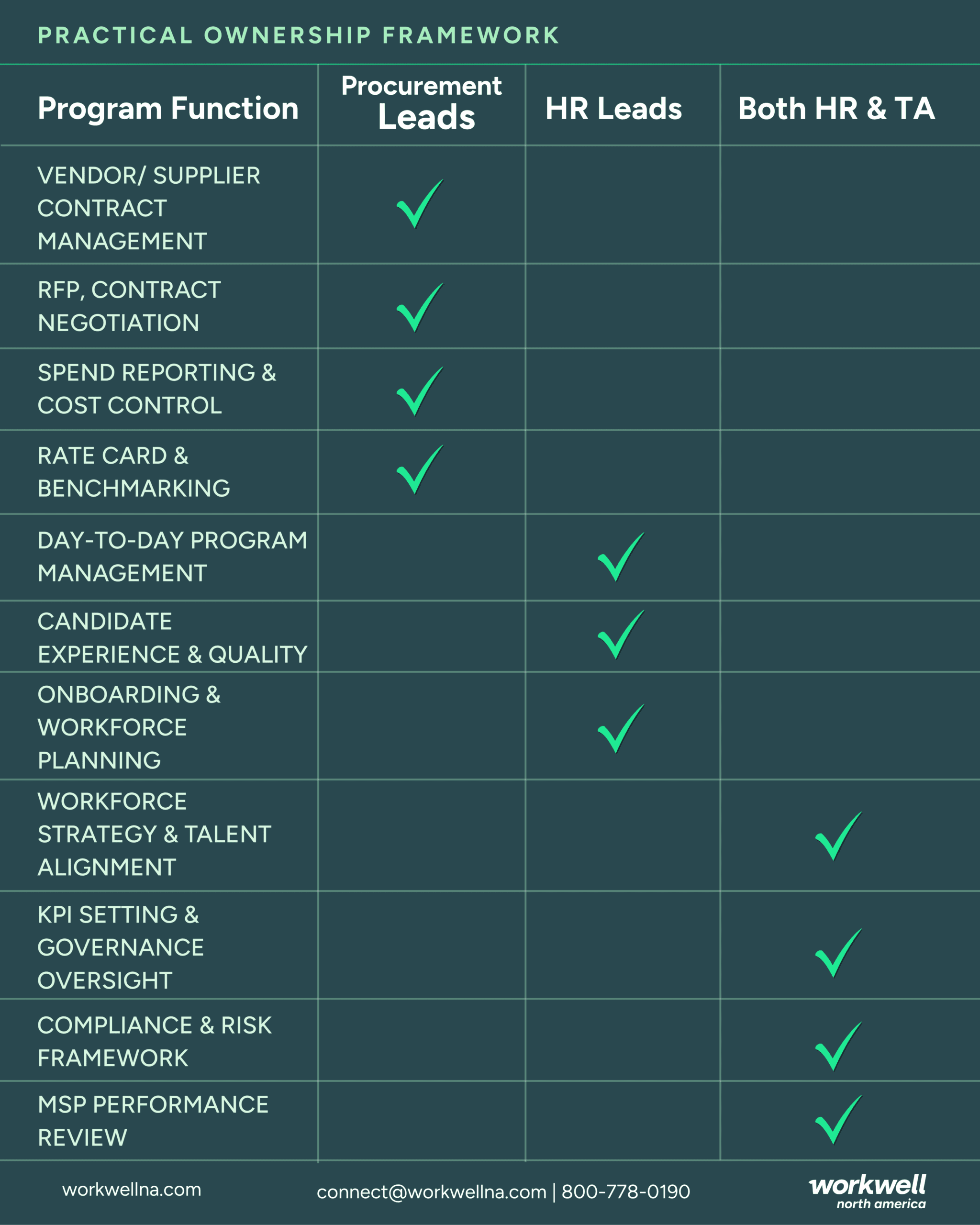
The principle here is straightforward: Procurement leads the commercial and supplier relationship side. HR leads the workforce and program execution side. Strategic decisions require both departments to be at the table: governance, KPIs, MSP performance review, and compliance frameworks.
Most programs succeed or fail in this shared space. Without an intentional, structured platform for joint decision-making, silos create the very problems you want to prevent. Thus, structured, shared governance is non-negotiable.
…But Someone Has to Be Accountable
Shared ownership of your contingent workforce program only works when accountability is tied to a name. Co-ownership must be intentional, with specific responsibilities and a designated executive sponsor to unify direction and resolve conflict.
Shared ownership works when:
- A single executive sponsor is responsible for the program’s outcomes and has the authority to settle disputes between different departments
- HR and Procurement have clearly defined lanes, agreed in writing, and not just assumed
- There is a regular joint governance cadence where both functions review program performance together against shared KPIs
- The MSP partner has a clear point of escalation when misalignment is creating operational friction
We begin every program implementation by discussing how governance and ownership will work in practice. The structure must identify decision-makers for rate card changes, supplier panel adjustments, and KPI dashboard ownership. These specifics must be established before the program launches so that all participants understand their roles and accountability.
What High-Performing Contingent Workforce Programs Actually Do Differently
From my experience across program implementations and conversations at events like ProcureCon, the organizations that have answered who owns your contingent workforce program correctly share several consistent patterns.
- They defined governance before selecting a vendor. The ownership structure was designed as part of the business case, not retrofitted after implementation.
- They created a cross-functional steering committee with both HR and Procurement represented. It needs to be an actual decision-making body with meeting cadence, shared reporting, and authority.
- They stopped measuring success with siloed metrics. Procurement stopped measuring only markup and cost. HR stopped measuring only time-to-fill. They created a shared scorecard to show business results. It includes hire quality, employee turnover, compliance status, and overall program value.
- They treated the MSP as a partner to both functions, not a vendor that reports to one of them. An MSP positioned solely under Procurement will be measured solely on cost. An MSP positioned solely under HR will be measured solely on fulfillment. The best programs measure both.
These patterns map closely to what separates Stage 3 and above programs from those still fighting over ownership. If you want to see where your program sits across all five dimensions, the contingent workforce maturity model lays out each stage with clear diagnostic signals.
A Note On Program Maturity
Where you are in the ownership conversation usually reflects where your program sits on the maturity curve. Not sure where that is? We mapped all five stages in The New Contingent Workforce Program Maturity Model. If ownership is still unresolved, Stage 2 is where to start.
Where your program sits in its maturity often determines how urgently you need to answer who should own your contingent workforce program.
Common Questions on Who Should Own Your Contingent Workforce Program
Who should own a contingent workforce program, HR or Procurement?
Neither HR or Procurement should own it exclusively. The best programs use a shared governance model. In this model, Procurement manages suppliers and commercial matters. Meanwhile, HR/Talent Acquisition handles the program execution and workforce strategy. A single executive sponsor holds accountability for overall program outcomes.
What happens when HR and Procurement disagree on program priorities?
This is one of the most common reasons programs underperform. When there isn't a clear escalation path of who should own your contingent workforce program and a joint governance forum, disagreements between departments can delay decision-making. This can lead to an inconsistent direction for the MSP and suppliers. The fix is structural: build the governance model before implementation, not after friction surfaces.
Who typically owns the relationship with an MSP?
In most companies, Procurement handles the contract and business relationship with the MSP. Meanwhile, HR or Talent Acquisition handles daily operations. Both need to be engaged in quarterly business reviews and KPI governance. An MSP focused on just one function tends to prioritize only that area, often missing the broader perspective.
How do we know if our current ownership structure is working?
If you're asking that question, it probably isn't. The most noticeable indicators are: each department has its own criteria for success; the MSP receives mixed messages from HR and Procurement; spending information is not fully transparent; or the program has not been formally evaluated in over a year. Any one of those is worth taking seriously.
Is there an industry consensus on who should own your contingent workforce programs?
There's growing agreement that shared ownership is the ideal approach. However, the details depend on the organization's size and the program's level of advancement. Staffing Industry Analysts highlighted that the best approach involves a collaborative model. This strategy leverages the strengths of both departments rather than choosing between them.
What happens when contingent workforce program ownership is unclear?
Programs without defined ownership develop predictable problems:
duplicate suppliers, compliance gaps, misclassified workers, and
disconnected spend data. Unclear contingent workforce ownership is a design failure that shows up in program performance.
In Summary
The HR vs. Procurement debate is the wrong frame. It turns a governance design problem into a political one, and that is where programs go to stall.
The organizations that get this right stop asking who should own your contingent workforce program and start asking how ownership will work in practice. They define governance before selecting a vendor. They build shared accountability into the structure from day one. They pick an MSP that knows how to operate inside a cross-functional model, not one that embeds itself in a single department’s reporting chain.
If your program is stuck in the ownership conversation, it simply reflects an issue in the way your program is designed. Fortunately, design flaws are easy to correct.

Not sure where your program stands?
Take our five-minute Program Maturity Assessment to find out where your contingent workforce program sits today, and what the next step looks like.